
Office Address
Seville, Spain
Seville, Spain
Phone Number
+(34) 624 816 969
Email Address
Available on Google Play

Seville, Spain
Seville, Spain
+(34) 624 816 969






 by ForgeNEX
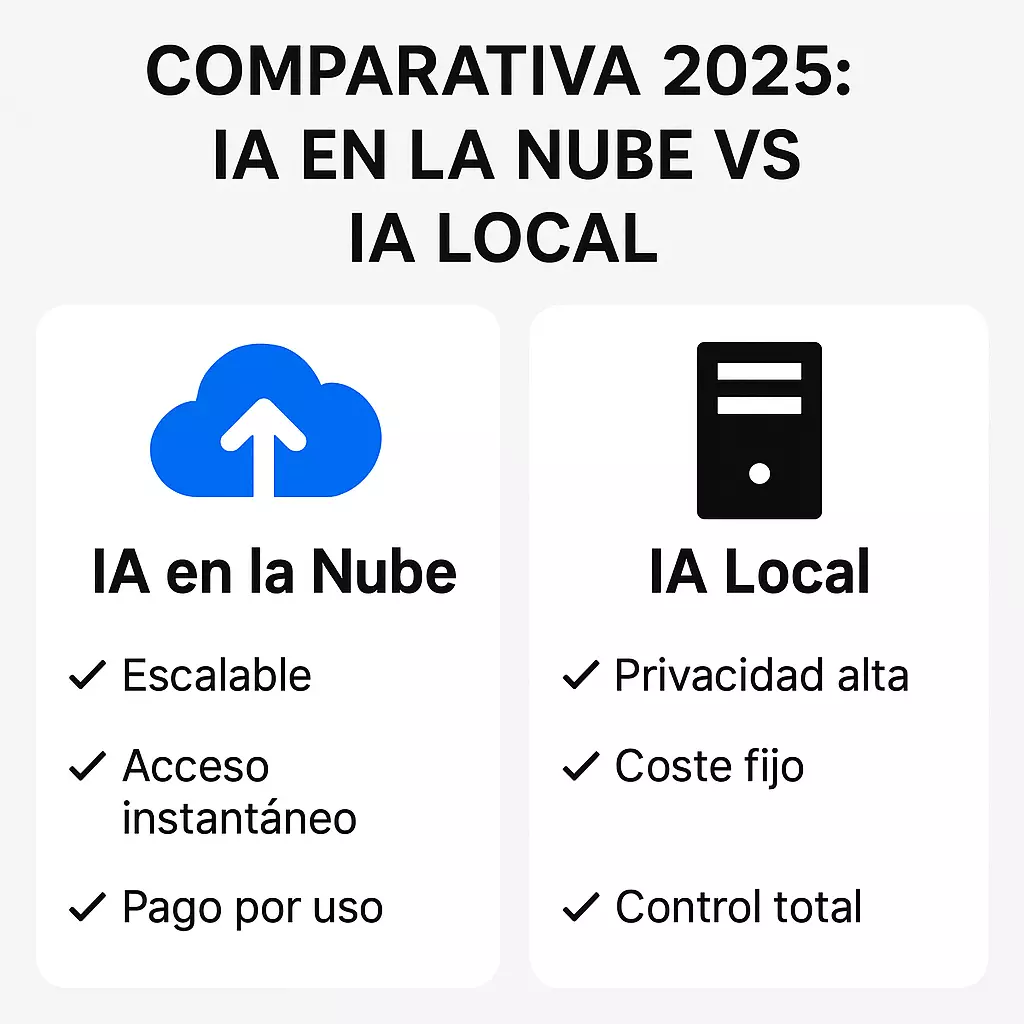
 Artificial intelligence (AI) has become an essential tool for businesses, developers, and content creators. However, when it comes to implementing a language or vision model, the key question arises: use cloud AI or local AI?
In this article, we will analyze both options, comparing performance, costs, privacy, and scalability, so you can choose the one that best suits your needs.
Table of contents [Show]
Cloud AI refers to models and services hosted on servers of providers like OpenAI, Google Cloud, AWS, Azure, or Hugging Face Spaces, accessible via the internet through APIs.
Advantages:
Disadvantages:
Ideal for: startups, projects with global users, or products that need state-of-the-art AI without worrying about infrastructure.
Local AI involves running models directly on your computer or server. Tools like Ollama, LM Studio, KoboldCpp, or AnythingLLM allow you to download and run models like Llama 3, Mistral, or Phi-3 on your own CPU or GPU.
Advantages:
Disadvantages:
Ideal for: companies with sensitive data, offline environments, or developers who want complete independence.
| Feature | Cloud AI | Local AI |
|---|---|---|
| Performance | Scalable on demand | Depends on own hardware |
| Cost | Variable, pay-per-use | Fixed after initial investment |
| Privacy | Limited | High |
| Maintenance | Low | Medium/High |
| Available Models | Latest generation | Limited to open-source |
| Connectivity | Requires internet | Can work offline |
There is no single answer. The cloud offers convenience and scalability, while local ensures control and privacy. In many cases, the optimal strategy is hybrid: using local AI for critical data and the cloud for massive or public-access tasks.
? SEO Tip: If you are looking to maximize performance and minimize costs, evaluate a mixed system and optimize which tasks you delegate to each environment. This way, you get the best of both worlds.
