
Office Address
Seville, Spain
Seville, Spain
Phone Number
+(34) 624 816 969
Email Address
Available on Google Play

Seville, Spain
Seville, Spain
+(34) 624 816 969





 by ForgeNEX
 Table of contents [Show]
A neutral router is a device that, unlike the one provided by the ISP, does not include a modem. That is, it does not connect directly to the fiber or ADSL line, but instead receives the already established connection from the ONT (Optical Network Terminal) or the modem left by the ISP.
Its sole mission is to manage network traffic as efficiently as possible, offering advanced control, stability, and better performance in both wired and wireless networks.
In other words: the neutral router focuses on what it does best, managing the local network and optimizing connectivity.
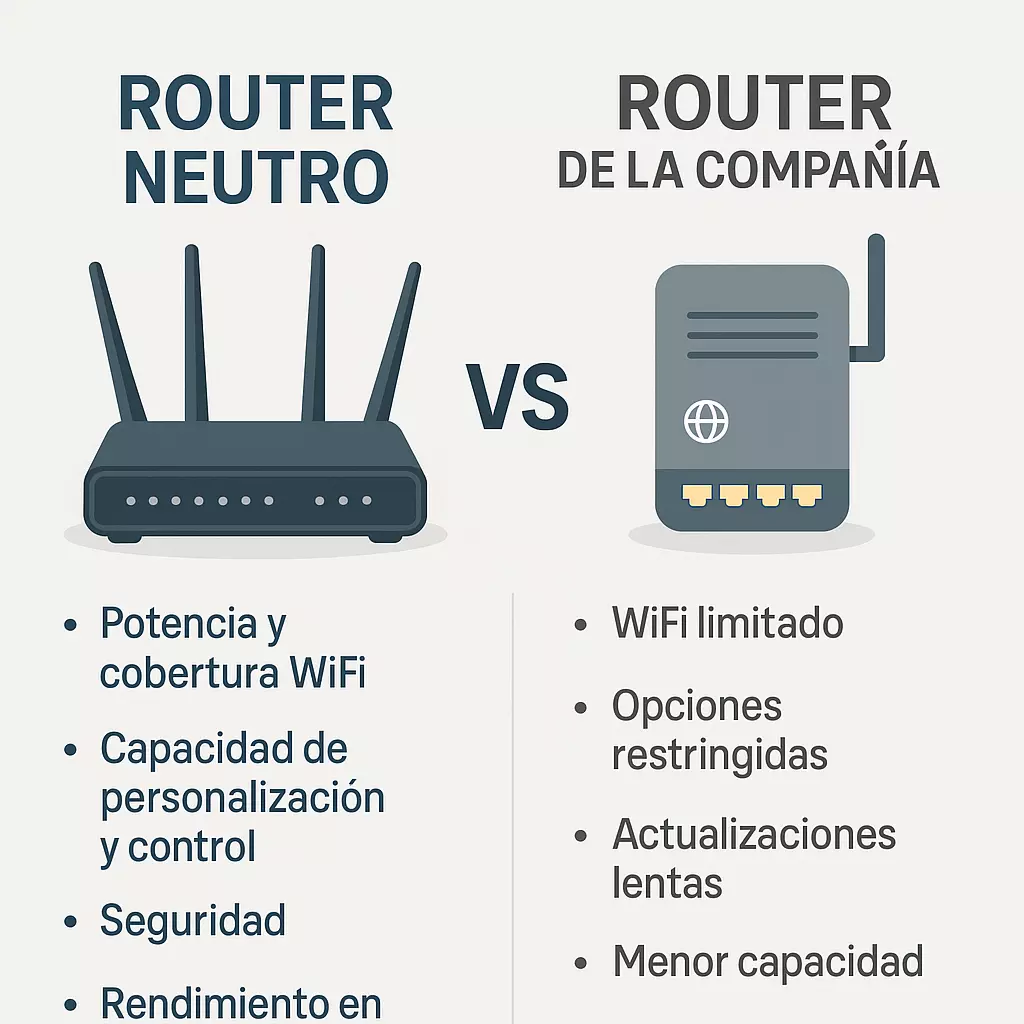
Routers provided by ISPs are usually generic devices, designed to reduce costs. The quality of their antennas, their actual range, and their ability to handle multiple devices simultaneously are quite limited.
In contrast, a mid-range or high-end neutral router can incorporate technologies like WiFi 6 or WiFi 6E, beamforming (signal focusing), MIMO (multiple inputs and outputs), and wider bandwidths, which translates into higher speed and stability.
ISP routers often come 'locked down': you cannot modify advanced parameters, their interface is limited, and in some cases, the ISP itself maintains remote access to the device.
With a neutral router, you have full control:
Creating VLANs to separate networks (work, guests, IoT).
Advanced firewall and security rule configuration.
Parental controls and time or bandwidth limitations.
Real-time traffic monitoring.
ISP equipment often takes a long time to receive firmware updates, and sometimes becomes obsolete in a few years. This can open the door to vulnerabilities.
Quality neutral router manufacturers, such as Asus, TP-Link, Netgear, or Mikrotik, release frequent updates and also allow installing alternative firmware (OpenWrt, DD-WRT, etc.), which strengthens user security and privacy.
If you work with video conferences, online gaming, home servers, cloud backups, or simply have dozens of connected devices, the ISP router falls short.
Neutral routers allow traffic prioritization (QoS), intelligently allocating bandwidth and supporting simultaneous connections without the network collapsing.
By using a neutral router, you can switch providers without depending on the model they provide. You only need to keep the modem/ONT and continue with your own equipment, which ensures a consistent network experience.
The answer depends on how you use the internet. If you only browse and watch some streaming, the ISP router may suffice. But if you're looking for:
Better WiFi coverage throughout the house or office.
Enhanced security against external attacks.
The ability to manage your network in detail.
Stability and performance in environments with many devices.
… then a neutral router is an investment that makes a difference.
The ISP router fulfills its minimal role: connecting you to the internet. However, a neutral router is designed to give you control, security, and connection quality. For advanced users, remote professionals, or businesses, it's not a whim, but a necessary step to ensure that the network is not a bottleneck in their daily lives.
At ForgeNEX, we always recommend considering network infrastructure as an essential part of your technological environment. And, if your connection is key to working or maintaining your business, investing in a neutral router is not a luxury: it's ensuring the foundation of your entire digital system.
