
Office Address
Seville, Spain
Seville, Spain
Phone Number
+(34) 624 816 969
Email Address
Available on Google Play

Seville, Spain
Seville, Spain
+(34) 624 816 969






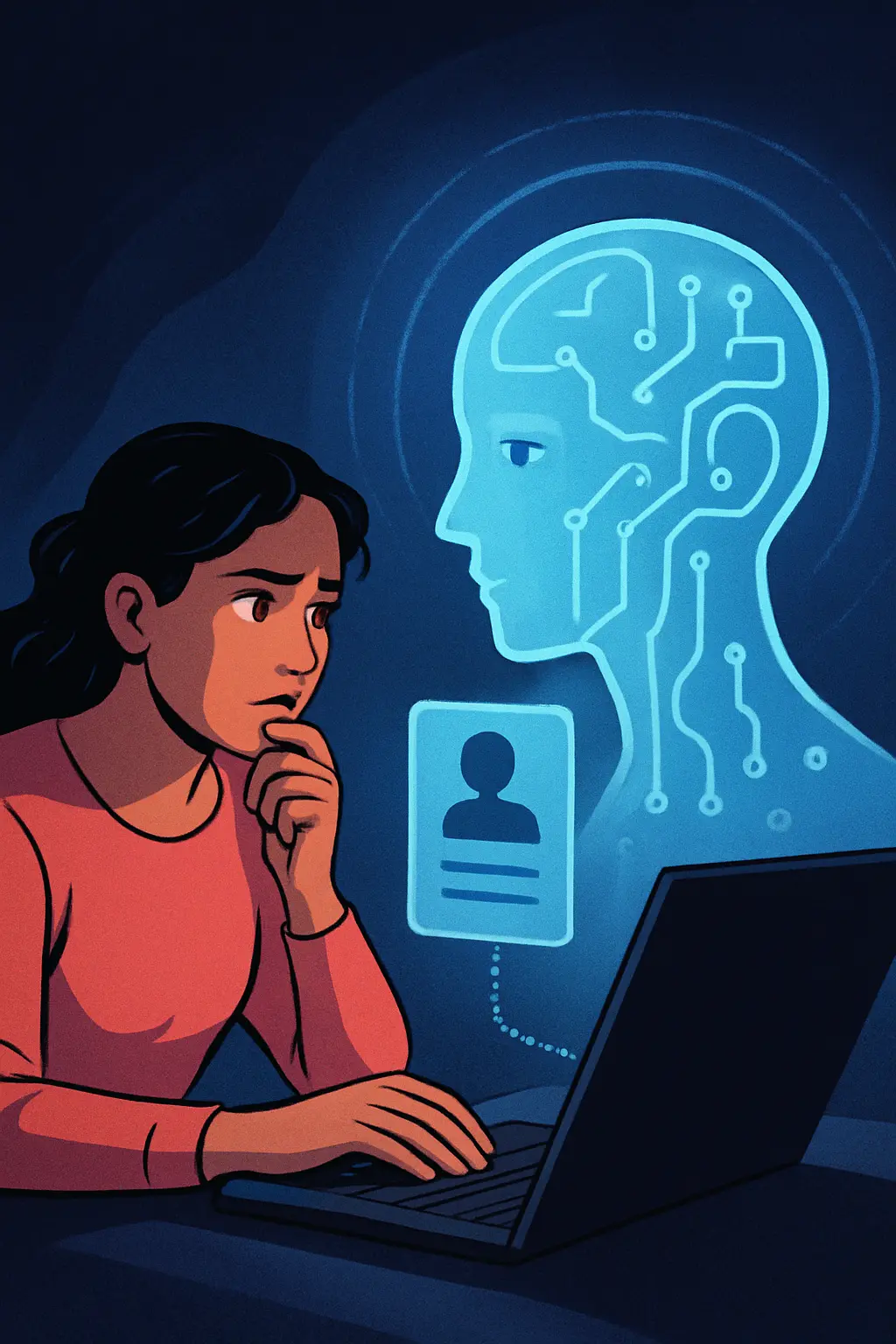
 by ForgeNEX
 Let's be honest for a second. By now, you've probably opened ChatGPT, Claude, or Copilot at least once today. Maybe it was to draft that awkward email you've been putting off since Monday, to debug a stubborn block of code, or simply to ask what on earth to cook with what's left in your fridge.
Generative Artificial Intelligence has slipped into our lives with the smoothness of someone entering a house with their own key. It's useful, it's fast, and often seems like magic. But here at the ForgeNEX office, between coffee and server deployments, we sometimes stop to think about the other side of the coin. Not the "Skynet is going to dominate us" side, but a much more earthly and pragmatic one: What are we giving up in exchange for that convenience?
We've been assuming for years that on the internet, "if the product is free, you are the product." We learned it with cookies, we accepted it with social media, and now we're signing a new social contract with AIs. One that goes far beyond knowing what sneakers you like. Today, we're going to unravel how this exchange really works, why your prompts are worth more than gold, and why, paradoxically, the only way for AI to be useful to you is by baring (digitally) your mind to it.
Table of contents [Show]
Let's start with the basics, what we often forget when we see the cursor blinking, waiting for our instruction. When you interact with most public language models (LLMs), there's an implicit agreement—and explicit in those Terms of Service that no one reads—that your information will be used.
For what? For training.
Many users have the false sense of privacy of an end-to-end encrypted WhatsApp conversation. But the reality is technically and logistically different. For these models to improve, they need real feedback. They need to know if their response helped you, or if it frustrated you so much that you regenerated the text.
And here comes the first "open secret": it's not just a machine reading you.
In the process of Reinforcement Learning from Human Feedback (RLHF), which is basically how we teach AI not to be toxic and to be useful, there are teams of real people (moderators and trainers) who review snippets of conversations. They don't necessarily read your first and last name, but they do read the content.
If you told the AI confidential details of your company's strategy or confessed an embarrassing medical problem, there's a non-zero probability that a human, somewhere in the world, has read that text to label it as "helpful response" or "hallucination." It's not movie-style espionage, it's quality control. But absolute privacy, in this context, is a myth.
This is where things get fascinating (and a bit unsettling). Think about it: What do you post on Instagram or LinkedIn? You post your best version. The beach photo, the recently earned title, the polished professional opinion. It's a curated facade. Social media has your demographic data and your superficial interests.
AI, however, has your doubts.
When you talk to an advanced chatbot, the dynamic changes.
See the difference? In that single prompt, you've given away:
The developer company doesn't need you to fill out a survey. Through the vectorization of your words and semantic analysis, a psychographic profile about you is generated that is infinitely deeper than the one Facebook has. They know how you think, what hurts you, what you're passionate about, and what your knowledge gaps are.
You're building, prompt by prompt, a digital twin of your psyche. And you do it voluntarily because you need the response to be good.
This is the most interesting technical and social turning point. You might think: "Okay, then I'll trick the AI. I'll use fake data or be very vague in my requests to protect my privacy."
Well, you can try. But here's where the model's mechanics come into play. LLMs are context prediction machines. The more context they have, the better they predict.
If you're a privacy-conscious user who tells the AI: "Write a sales email" without giving details, the AI will return a generic, robotic, and practically useless template. You'll feel like the tool "doesn't work."
For the AI to work its magic, to truly save you time and work for you, you need to give it the real context.
It's a performance paradox: The system "punishes" you with mediocrity if you don't give it your real data. And it "rewards" you with excellence and productivity the more you expose yourself.
It's a very subtle operant conditioning. We quickly learn that to get value, we must shed privacy baggage. Those who try to "poison" their data or stay anonymous get a clumsy tool. Those who surrender to the algorithm get a brilliant assistant.
If in the Web 2.0 era (Google, Meta) the product was our browsing habits to sell us things, in the AI era (Web 3.0 or whatever we want to call it this week), the product is our intention and cognition.
It's not about a dark conspiracy where there's a man stroking a cat and laughing at your secrets. It's simply the business model of the data economy taken to the next level.
All that information you're dumping (your pains, your business ideas, your mental structures) has incalculable value for the future.
We're training the machine to know us better than we know ourselves. And unlike social media, where we're passive (we scroll), here we're active (we create, ask, confess).
It's fascinating to see how, in technical and privacy forums, this is already being discussed. There are users who try to obfuscate their data, using fake names or altering key details of their stories before pasting them into the chat. But it requires mental effort.
Inertia leads us to comfort. Most users won't anonymize their data. They'll simply accept that, for the AI travel assistant to plan their perfect vacation, they have to tell it how much money they have, who's traveling with them, and what kind of experiences they hate.
This makes AI companies the holders of the most powerful sociological database in history. They don't just know what we do, they know why we do it.
From ForgeNEX, the answer is a resounding no. Technology is an incredibly powerful tool that drives productivity and creativity. Refusing to use it is falling behind.
However, the key lies in awareness.
Just as we learned not to put our credit card on websites without HTTPS lock or not to accept cookies from dubious sites, we must develop "AI hygiene":
At the end of the day, AI is a mirror. It reflects back what we give it. If we give it truth, it returns utility. The price is our granular privacy. It's an exchange most of us are willing to make, but that, at the very least, we should sign with our eyes wide open.
And you? Are you one of those who tells the AI everything so the result is perfect, or do you prefer to keep your distance and get generic answers?
At ForgeNEX, we help companies integrate AI securely, protecting their critical data and leveraging the power of current models. If you're concerned about the privacy of your corporate data, let's talk.