Table of contents [Show] [Hide]
Concept 1: The Language Model – The Digital Brain
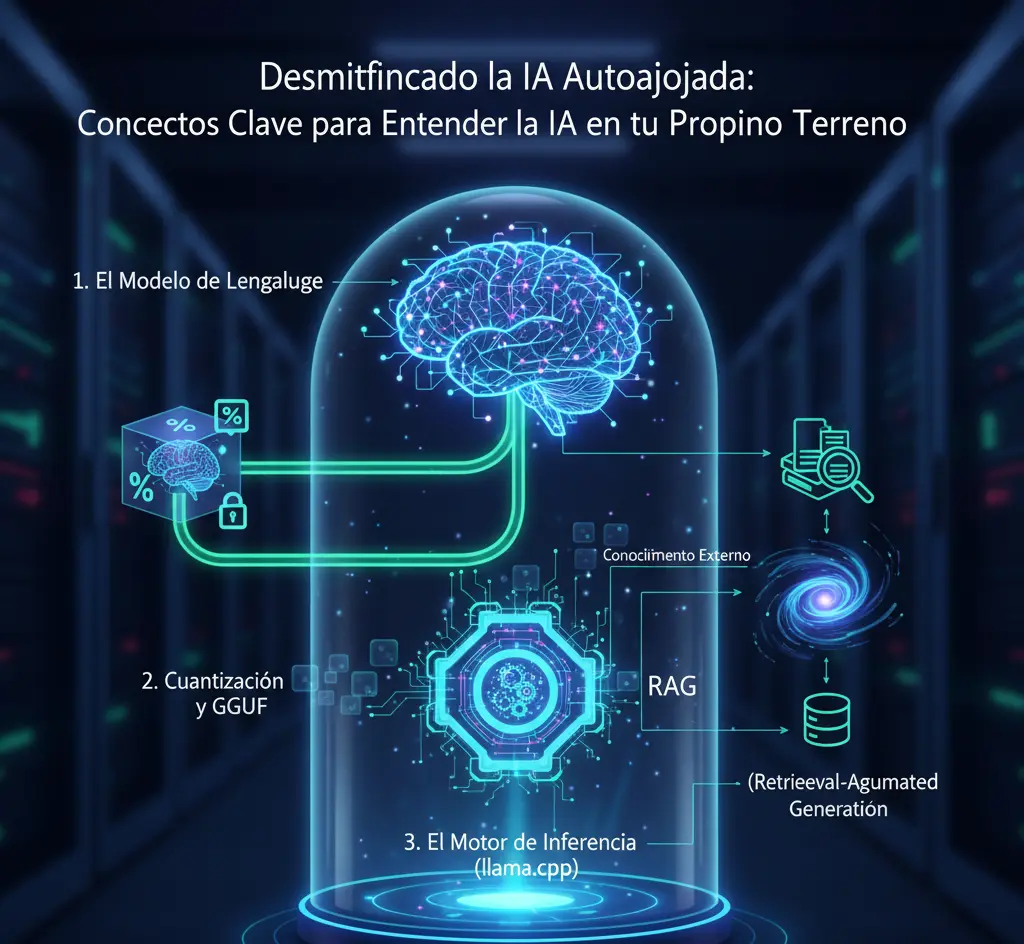
Everything starts with the model. Think of it as an immense digital brain, trained to understand and generate human language.
- What is it exactly? It's a neural network with billions of parameters (think of them as the "neurons" and their connections). These parameters, called weights, are the result of massive training on vast amounts of text from the internet. The weights store all the model's "knowledge."
- How is it stored? A model isn't a program but a very large data file (from several gigabytes to over a hundred). This file contains the weights that define its behavior. Popular open-source models like Llama 3, Mistral, or Phi-3 are the raw material we work with.
Concept 2: Quantization and GGUF – The Art of Making It Fit
The main obstacle to running these giant "brains" is their size. A 7-billion-parameter model in its original format (FP16) needs about 14 GB of VRAM, something out of reach for most people. This is where quantization comes in.
- What is Quantization? It's a compression technique. Imagine you have a high-resolution image with millions of colors. Quantization would be like intelligently reducing the color palette. In LLMs, instead of storing the numbers (weights) with high precision (e.g., 16-bit), we reduce them to 8, 5, 4, or even 2 bits. This drastically reduces the file size and the required VRAM, often with an imperceptible loss of quality.
- What is GGUF? It's the magic file format that makes this possible for everyday use. Created by the
llama.cpp team, GGUF (GPT-Generated Unified Format) is a container that packages the model's already quantized weights into a single file. Its genius is that it's designed to be loaded and executed ultra-efficiently on both GPU VRAM and system RAM for CPU processing. It is the de facto standard for local inference.
Concept 3: The Inference Engine – Putting the Brain to Work
Having a GGUF file isn't enough; you need a program that knows how to read it and use it to generate text. That program is the inference engine.
- What is "Inference"? It's the process of using an already trained model. When you send it a prompt and receive a response, you are performing inference. This is distinct from "training," which is the much more costly process of creating the model from scratch.
- The King:
llama.cpp. This is the software project that powers almost the entire local AI ecosystem. It's an incredibly optimized inference engine, written in C++, capable of running GGUF models by making the most of any available hardware: NVIDIA, AMD, and Apple Silicon GPUs, as well as CPUs. Tools like Ollama, LM Studio, or Jan.ai are, in essence, user-friendly interfaces that use llama.cpp under the hood.
Concept 4: RAG (Retrieval-Augmented Generation) – Giving It External Memory
A base LLM only knows the information it was trained on. It knows nothing about your private documents, your emails, or what happened in the world yesterday. RAG is the technique that solves this by giving the model access to external knowledge in real-time.
- The Process, Simplified:
- Indexing: First, you take your documents (PDFs, websites, etc.), split them into small text chunks, and use an embedding model to convert each chunk into a vector (a list of numbers representing its meaning). These vectors are stored in a vector database.
- Retrieval: When you ask a question, your question is also converted into a vector. The system then searches the database for the text chunks whose vectors are most "similar" or closest to your question's vector.
- Augmentation and Generation: The system takes the most relevant chunks it found and places them into the prompt it sends to the LLM, along with your original question. The final instruction looks something like this: "Based solely on the following context, answer this question. Context: [Chunk 1, Chunk 2, ...]. Question: [Your original question]".
In short, RAG is like giving the LLM an open-book exam: you don't ask it to recall the answer, but to find it in the documents you provide at that moment.
Conclusion: The Pieces of the Puzzle
Understanding these four key concepts allows you to see the self-hosted AI ecosystem not as a black box, but as a system composed of interconnected pieces:
- You choose a Model (the brain).
- You get it in GGUF format with the right quantization for your hardware (the compressed version).
- You use an Inference Engine (like
llama.cpp via Ollama) to run it (the engine that makes it work). - Optionally, you build a RAG system on top of it to give it specific knowledge (the external memory).
Mastering these fundamentals is the first step from being a simple AI user to becoming a creator capable of building private, customized, and truly powerful solutions.







 by ForgeNEX