
Office Address
Seville, Spain
Seville, Spain
Phone Number
+(34) 624 816 969
Email Address
Available on Google Play

Seville, Spain
Seville, Spain
+(34) 624 816 969





 by ForgeNEX
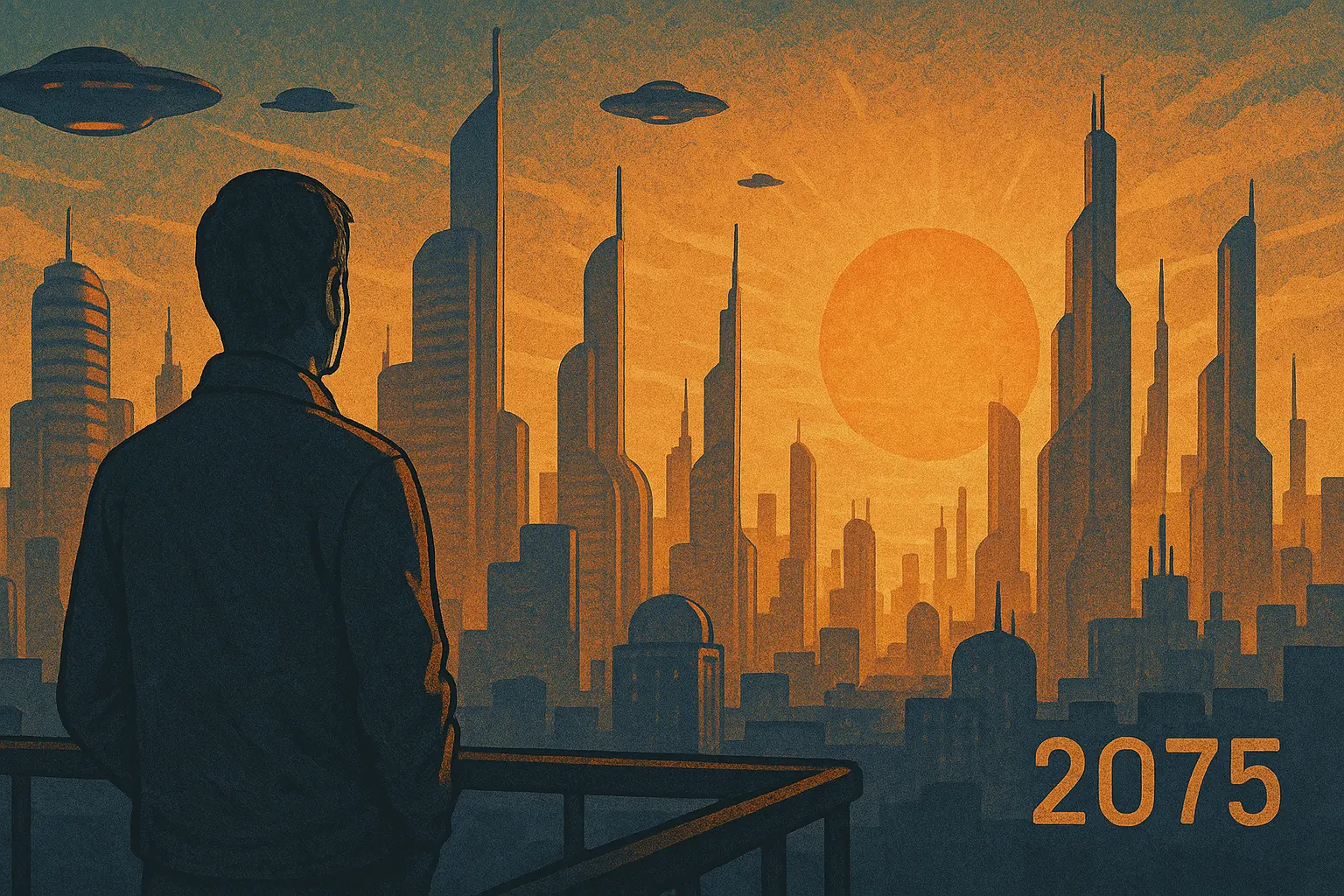
 Forget about flying cars and world-dominating robots for a moment. That's our grandparents' science fiction. The reality of artificial intelligence in 50 years will be much more intimate, infinitely more useful, and so integrated into our lives that we'll struggle to remember how we ever lived without it. Imagine a world where technology isn't something you use, but a companion that understands you.
Let's take a walk through an ordinary day in the year 2075. I'm not going to tell you about it like a technology lesson; I'm going to show you so you can experience it. Are you coming?
Table of contents [Show]
Your day no longer begins with the jarring sound of an alarm. Instead, the lights in your room simulate a soft, gradual sunrise, perfectly synchronized with your REM sleep cycle. Your Ambient Assistant, a decentralized and private AI that manages your home, has analyzed your sleep quality overnight through passive sensors in your mattress. It noticed slight tension in your back, so it has subtly increased the shower temperature and prepared a playlist with sound frequencies designed to relax your muscles.
As you get dressed, you ask the air, "Hey, Kai, what's the world like today?" The voice of your assistant, a perfect neural replica of your grandfather's that you authorized, responds. It doesn't read you a list of chaotic news. Instead, it presents a five-minute visual and auditory summary of the updates that truly matter to you, filtering out the noise and misinformation. It knows you're interested in the progress of regenerated coral reefs in Australia and the latest match of your favorite e-sports league.
In the kitchen, your personal AI nutritionist has already worked its magic. Last night, the sensors in your toilet (yes, you read that right) performed a complete biochemical analysis. They detected a slight potassium deficiency and a slightly elevated sugar level. That's why the breakfast your smart kitchen suggests today is a smoothie with spinach and banana and some slow-fermented bread toast. It's not an order; it's a friendly suggestion to help you feel better throughout the day.
Suddenly, a discreet notification appears on the kitchen wall. It's a hologram of your AI doctor. It's not an emergency. It has simply correlated your sleep data, your biochemical analysis, and your week's schedule and warns you that your stress levels might increase. It suggests a 10-minute AI-guided meditation session at noon or adjusting your work environment to reduce blue light in the afternoon. You choose. Medicine is no longer reactive; it's now hyper-preventive. Human doctors no longer diagnose colds but supervise the health of thousands of people through these AIs, intervening only in the most complex and creative cases.
The idea of going to a 9-to-5 office is something your grandchildren study in history class. Many repetitive jobs have disappeared, not because AI "stole" them, but because it made them irrelevant. Driving a truck, analyzing financial balance sheets, or drafting contracts are tasks that machines do with unattainable efficiency.
So, what do you do? You focus on what machines (still) can't do well: creativity, empathy, strategic thinking, and human connection. Today, you work as an "Adventure Experience Designer." Your client is a family that wants a vacation recreating the first expedition to the Amazon.
Your work partner is an AI you converse with. You throw ideas at it: "I want them to feel the awe of seeing an anaconda for the first time, but safely. How do we do that?" The AI processes millions of data points on biology, geography, psychology, and augmented reality simulation in seconds. It returns three complete proposals: a hyper-realistic holographic simulation in a controlled biodome, a shared virtual reality experience with haptic feedback, or a trip to a protected reserve where invisible drones ensure safety and project data about the fauna onto smart contact lenses. You, the human, make the final decision, providing the emotional touch and deep understanding of the client.
Education has completely changed. There are no more four-year university degrees that become obsolete. Learning is a constant, personalized flow. Today, you want to learn to play the hang drum.
You put on augmented reality glasses, and a holographic tutor appears before you. It's an AI trained on the styles of the world's best musicians. It analyzes your hand position, corrects your rhythm in real-time, and adapts the lesson to your learning speed. If you get frustrated, it detects it from your body language and switches to an easier exercise to keep you motivated. In one hour, you've learned more than in weeks of watching online videos. Education is now a custom-tailored suit, not a one-size-fits-all garment.
You're meeting a friend who lives in Kyoto. You don't have a video call. You enter a shared virtual space that perfectly recreates an old tapas bar in Seville. You can see each other's realistic avatars, feel the warmth of the lamps, and almost smell the ham. Your implanted neural translators (or discreet earbuds) eliminate any language barrier. The conversation flows without interruption, as if you were sitting across from each other.
But the AI goes further. Your friend tells you he's feeling a bit down. Your personal assistant, with your permission, discreetly shares with his that a conversational therapy session with an AI specializing in cognitive psychology helped you a lot last week. It's not an intrusion; it's a digital bridge to facilitate empathy and mutual care.
As you can see, the AI of 2075 is not a robot that serves you coffee. It is a digital nervous system, an invisible thread that optimizes, personalizes, and enriches every facet of your life. It manages the world's logistics (traffic, energy, supply chains) so efficiently that the cost of living has drastically reduced. It frees you from tedious tasks so you can dedicate yourself to what makes you human.
Of course, this future is not without its monumental challenges. Ethics, data privacy, and the risk of a dehumanized, overly automated society are constant debates that humanity has had to face. But in this optimistic future, we have learned to use AI not as a replacement, but as an augmentation of our own abilities.
AI will have become the brush with which we paint the canvas of our lives, allowing us to create works we never would have imagined. And that, more than any flying car, is a future worth being immensely curious about.
#ArtificialIntelligence #FutureOfAI #AI2075 #Technology #FutureSociety #DailyLife #Innovation #ForgeNEX #Singularity