
Office Address
Seville, Spain
Seville, Spain
Phone Number
+(34) 624 816 969
Email Address
Available on Google Play

Seville, Spain
Seville, Spain
+(34) 624 816 969


 by ForgeNEX
 The generative AI hype cycle has officially settled. By 2026, businesses are no longer impressed by generic chatbots writing poems; they demand tangible ROI, absolute data privacy, and strict compliance with the EU AI Act and GDPR. Sending sensitive corporate data, customer leads, or proprietary code to OpenAI or Anthropic APIs is increasingly viewed as an unacceptable security risk and an unpredictable recurring expense. The solution is self-hosted, local Large Language Models (LLMs).
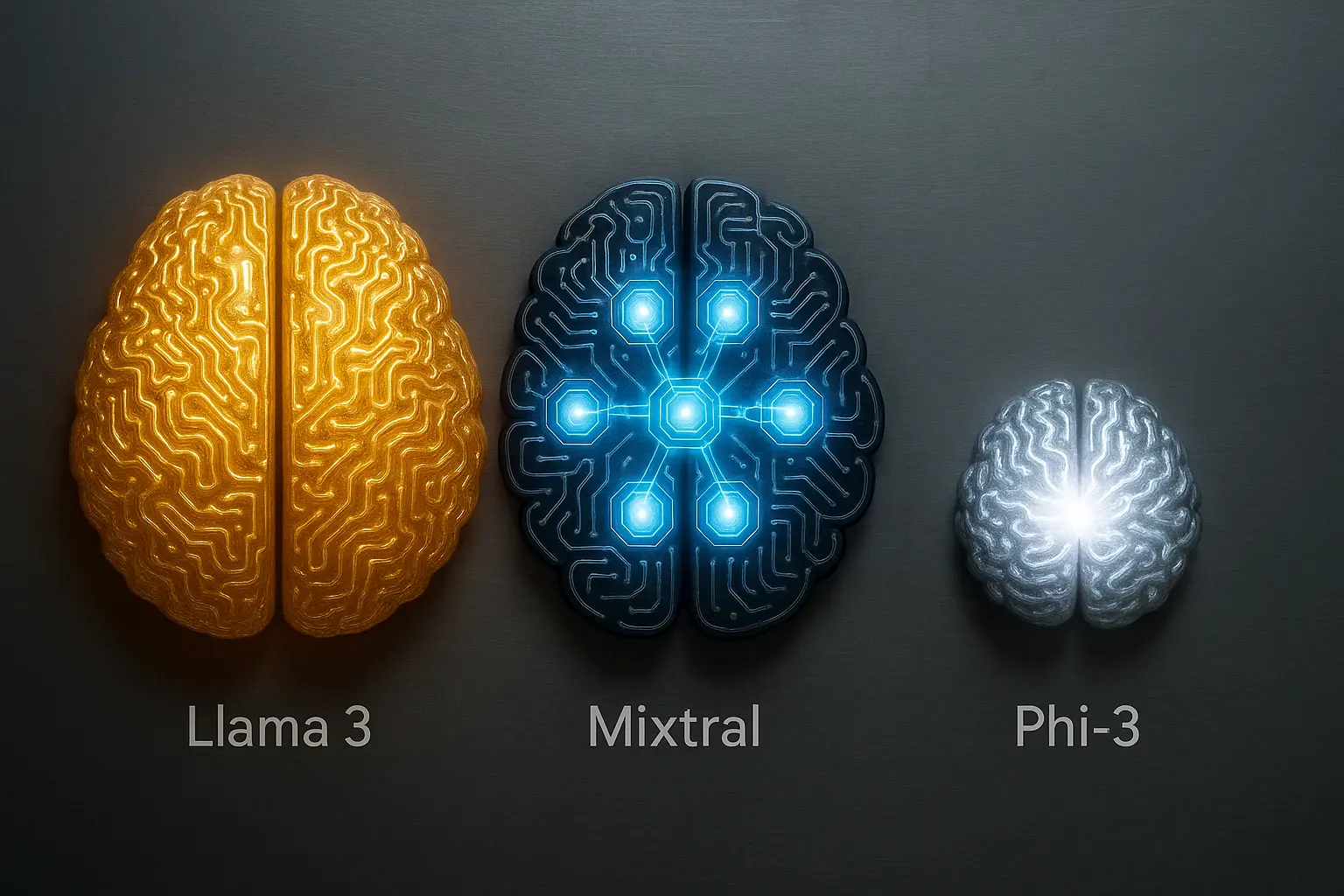
The open-weight ecosystem has evolved at a staggering pace. What began as a battle of generic text generators has fractured into highly specialized tools. The three undeniable pillars of the 2026 local AI landscape are Meta’s Llama family, Europe’s Mistral models, and Microsoft’s Phi Small Language Models (SLMs). While all three can run on your own hardware, choosing the wrong architecture for your specific business task—whether it's Retrieval-Augmented Generation (RAG), CRM chat automation, or bulk data extraction—will result in bottlenecked servers, hallucinated data, and frustrated teams. This comprehensive guide dissects the technical realities of these three architectures to help you choose the right engine for your business.
Table of contents [Show]
To evaluate these models, we must look at their current 2026 iterations. The names Llama 3, Mistral, and Phi-3 laid the foundation, but their current architectures are what you will actually deploy in production today.
Meta’s Llama remains the industry standard. With the release of the Llama 3.3 series and the rollout of Llama 4, Meta has focused heavily on massive context windows (up to 128k and beyond) and deep, multi-step reasoning. These are dense models, meaning every parameter is active during generation. They are the "heavy lifters" of the open-source world, offering reasoning capabilities that rival proprietary frontier models like GPT-4o, but they require significant VRAM (Video RAM) to operate smoothly.
The pride of the European AI sector, Mistral took a radically different approach. Instead of relying solely on dense architectures, they popularized Mixture of Experts (MoE) for the masses. A model like Mixtral 8x22B might have 141 billion parameters in total, but it only uses about 39 billion parameters during the generation of a single token. This means you get the intelligence of a massive model with the inference speed of a much smaller one. Furthermore, Mistral models are aggressively optimized for multilingual tasks (flawless Spanish, French, German, and English), making them indispensable for EU-based operations.
Microsoft proved that data quality beats sheer parameter count. The Phi models (ranging from 3.8B to 14B parameters) are trained almost exclusively on "textbook quality" synthetic data and heavily filtered web content. They are Small Language Models (SLMs). They do not possess the broad world knowledge to write a thesis on 18th-century philosophy, but if you give them a chunk of text and ask them to extract an invoice number, they will do it with 99% accuracy in milliseconds, running on a standard laptop CPU or minimal VPS.
RAG involves connecting an LLM to your internal documents (PDFs, Notion workspaces, HR manuals) via a vector database so it can answer questions based strictly on your data.
Businesses run on structured data, not prose. If you need to read 1,000 incoming support emails daily and output a JSON file classifying the sentiment, urgency, and product_mentioned, you need strict formatting adherence.
Customer-facing chat requires three things: low latency (responses under 1 second), conversational empathy, and strict adherence to system prompts (so the bot doesn't accidentally offer a 90% discount).
Self-hosting is only profitable if the hardware overhead doesn't exceed API costs.
To run Llama 70B (Quantized), you need a minimum of 40GB to 48GB of VRAM. This means investing in dual NVIDIA RTX 3090/4090 setups, or a high-end Mac Studio M4 Max with 64GB+ of unified memory. It requires dedicated infrastructure.
To run Mixtral 8x7B, you need about 24GB of VRAM. A single NVIDIA RTX 3090 or 4090 handles this effortlessly, providing an excellent middle ground of high intelligence and manageable hardware costs.
To run Phi-4, you need practically nothing. It requires 4GB to 6GB of RAM. It runs flawlessly on standard office laptops, edge devices, or basic $20/month cloud VPS instances. If your business task can be solved by Phi, it is economically irresponsible to use anything larger.
Theoretical benchmarks are fine, but production environments are ruthless. At ForgeNEX, we faced this exact decision matrix when rebuilding our proprietary Nexgestion CRM. We transitioned the core architecture from PHP to a highly optimized Python backend with a QT interface, specifically engineered for aggressive lead capture, automated omni-channel chat, and deep client management.
Sending our clients' sensitive lead data to public APIs was a non-starter for our advanced data services division. We required a local, sovereign AI stack.
Our Architecture Choice: Within Nexgestion, we utilize a hybrid model approach. We deploy Phi-4 (quantized via GGUF) for the frontline chat automation. Because it is incredibly lightweight, it handles hundreds of simultaneous incoming WhatsApp and web leads with zero perceived latency, categorizing intent and extracting contact info.
When a lead requires complex technical troubleshooting or requests a detailed proposal based on the company's historical PDF service catalogs, Nexgestion seamlessly routes the query to an internal Mistral NeMo instance running on our private ForgeNEX servers. This provides our CRM clients with the illusion of a massive, omniscient AI, while we maintain strict cost controls, sub-second latency, and absolute GDPR compliance. Ultimately, in 2026, the best LLM is rarely a single model; it is a meticulously orchestrated pipeline of specialized local experts.