
Office Address
Seville, Spain
Seville, Spain
Phone Number
+(34) 624 816 969
Email Address
Available on Google Play

Seville, Spain
Seville, Spain
+(34) 624 816 969





 by ForgeNEX
 Running large language models directly on your own hardware is no longer a feat reserved for researchers. As of mid-2026, local AI is a daily reality for developers, enterprise teams, and power users who prioritize privacy, control, and zero token costs. The three most popular tools in this ecosystem —Ollama, LM Studio, and AnythingLLM— have evolved tremendously since their early versions, introducing paradigm-shifting updates like remote encrypted linking, built-in cloud hybrid options, and native tool orchestration. This comprehensive guide breaks down each platform, compares them on the criteria that actually matter today, and gives you a clear answer based on your use case.
Table of contents [Show]
Before comparing, it is fundamental to understand that these three tools are not exactly direct competitors: they operate at different layers of the local AI stack.
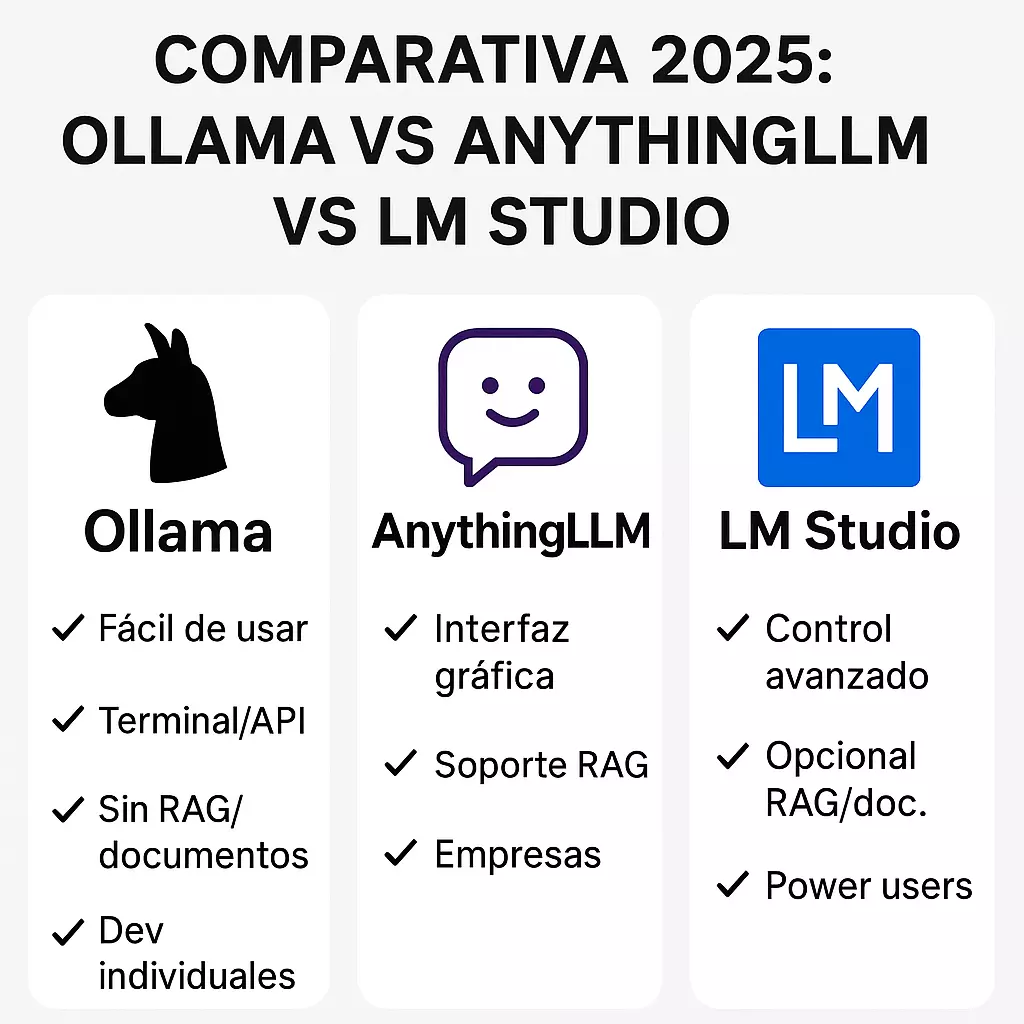
Ollama is a highly optimized inference engine designed to download, manage, and run LLM models from the command line. Its philosophy is minimalist but wildly powerful: it exposes an OpenAI-compatible REST API at localhost:11434, making it the industry standard backend for countless applications. While it caters perfectly to developers who want granular control via terminal, recent updates have expanded its ecosystem into app deployment and hybrid cloud execution.
LM Studio is a complete desktop client and local server environment with a rich GUI that allows you to discover, download, and run models seamlessly. It provides a highly configurable backend compatible with multiple APIs (OpenAI, Anthropic) and has recently expanded into headless server daemon deployments and remote encrypted instances. It is the gold standard for discovering and testing new models without technical friction.
AnythingLLM is not an inference engine, but an AI orchestration platform. It delegates model execution to Ollama, LM Studio, or cloud providers, focusing its power on the top layer: RAG (Retrieval-Augmented Generation), advanced multi-step agents, native tool calling, multi-user workspaces, and website embedding. It acts as the "business brain" connecting your documents and workflows to the underlying AI engine.
Ollama has made massive architectural leaps through early 2026 to support the latest frontier models:
ollama launch <app> command instantly spins up integrated local apps (like OpenClaw) directly from the CLI, streamlining developer workflows.LM Studio's 0.4.x releases have firmly bridged the gap between personal exploration and professional infrastructure:
/v1/messages endpoint allows developers to natively connect tools like Claude Code directly to LM Studio models.lms load --estimate-only calculate exact VRAM/RAM footprints dynamically before loading models.--parallel flag allows running multiple asynchronous predictions simultaneously for high-throughput setups.AnythingLLM's v1.12 update cycle has cemented it as the ultimate productivity environment for teams and agents:
| Criterion | Ollama | LM Studio | AnythingLLM |
|---|---|---|---|
| Tool Type | Inference Engine | GUI Client + Local/Remote Daemon | Orchestration Platform |
| Interface | CLI + Basic Desktop / Native Apps | Complete GUI + CLI | Complete Web UI + Desktop App |
| RAG with documents | Via external nodes/extensions | Not native | ✅ Core feature |
| Agents & MCP Tools | Native execution via API | Stateful API + Full MCP | ✅ Automated Multi-step Agents |
| API Standards | OpenAI-compatible | OpenAI & Anthropic (Claude) APIs | Consumes APIs (Acts as orchestrator) |
| Multi-user/roles | No | No | ✅ Built-in RBAC |
| Docker Installation | ✅ Official | Via llmster Daemon | ✅ Official |
| Privacy | 100% local (Pro tier optional) | 100% local (LM Link E2E encrypted) | 100% local |
| Ideal for | Devs, backend pipelines, fast scripts | Testing architectures, Claude integration | Teams, workspaces, internal wikis |
Raw token generation speed relies entirely on your hardware and quantization level. However, backend optimizations matter:
Ollama utilizes cutting-edge memory management built around `llama.cpp` advancements, aggressively targeting optimal utilization on Apple Silicon (M-series architectures) and maximizing parallel requests for those using its new Pro tier or local GPU clusters.
LM Studio enables granular tuning. You can split model execution precisely between CPU and specific GPUs (ideal for systems with mismatched VRAM setups) and features a dynamic CLI estimator that accounts for Flash Attention and visual context payloads prior to loading the weights.
AnythingLLM dictates pipeline logic rather than neural net processing. It has reduced its overhead drastically in 2026 via a Rust rewrite for internal transcriptions. For its vector ingestion, it continues to default to highly efficient on-device LanceDB logic, keeping VRAM overhead minimal while executing RAG workflows.
For 7B-9B parameter models (e.g., Llama 3/4 variants, Gemma, lightweight Qwen):
For 30B+ Agentic Models (e.g., Qwen 3.6 35B, Nemotron 30B MoE):
For 70B - 200B+ models (e.g., DeepSeek-V4-Flash):
Ollama is your core tool. Whether scripting with Python, structuring logic in PHP, or orchestrating via n8n, Ollama offers zero-friction API connectivity. The introduction of ollama launch makes integrating external tools faster than ever, cementing it as the foundational infrastructure for SaaS integrations requiring invisible LLM processing.
LM Studio is unmatched here. For rapid prototyping or comparing the logic loops of a DeepSeek MoE versus a Qwen 3.6 dense architecture, the Hugging Face GUI connection is flawless. The new Anthropic API endpoint configuration also transforms LM Studio into a powerhouse for developers wanting to run Claude tools over entirely local, cost-free infrastructure. Furthermore, if you manage a remote GPU rig, LM Link provides secure access seamlessly.
AnythingLLM is the absolute victor. Rather than spending weeks stringing together LangChain scripts, AnythingLLM provides out-of-the-box workspaces, deep document citations, web search verification, scheduled job cron tasks, and strict Native Tool Calling logic. It isolates multi-user environments with robust RBAC, converting generic LLM responses into auditable, factual business logic based purely on internal resources.
The ecosystem is modular. You do not have to choose just one; in professional environments, they interlock to form an incredibly resilient local AI stack:
localhost, executing native tool calls and managing the vector databases for team members accessing via the web UI.While the "Big Three" cover 95% of use cases, the local landscape contains other robust alternatives depending on your highly specific constraints: